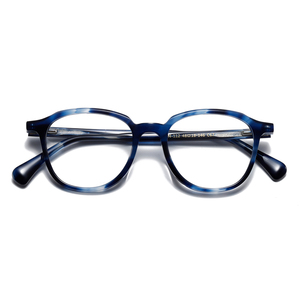
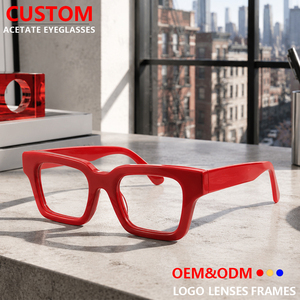
Engineered with high-density cellulose acetate sheets, wire-core reinforced temples, and hand-buffed finishes. Browse our production-ready configurations or commission tailored boxing dimensions for your domestic market.
The eyewear landscape across the Republic of Ireland is experiencing a profound architectural shift. In major optical retail corridors—ranging from Dublin's prestigious Grafton and Henry Streets to high-street independent optometrists in Cork, Galway, and Limerick—consumer search intent has pivoted aggressively toward bold, expressive silhouettes. Oversized acetate frames, characterized by substantial 6.0mm to 10.0mm rim cross-sections, are no longer considered seasonal fashion novelties; they have become the quintessential daily signature piece for European professionals and style-conscious wearers alike.
From a technical distribution standpoint, oversized frames in the Irish market demand exacting mechanical engineering. Unlike lightweight thin-wire metal frames, oversized acetate spectacle frames must reconcile significant lens apertures (typically boxing eye sizes ranging from 54mm to 59mm) with exceptional structural equilibrium. Without precise weight distribution, ergonomic bridge contouring, and integrated stainless steel temple cores, heavy frames cause chronic nasal pressure and forward slippage.
Rushabh Trading Company (RTC Eyewear) bridges this exact gap for Irish optical importers. Backed by over four decades of dedicated cellulose acetate machining since 1985, our manufacturing facility engineers oversized silhouettes that maintain bold, high-impact aesthetic mass while distributing facial contact pressure evenly across the zygomatic arches and nasal dorsal line.
Ireland’s oceanic maritime climate presents a demanding environment for synthetic polymers. Cheap injection-moulded plastics (such as TR90 or low-grade polycarbonates) suffer from plasticizer migration, surface crazing, and structural embrittlement when exposed to constant coastal mist, intermittent rain, and rapid indoor heating transitions. Organic cellulose acetate—synthesized from refined natural cotton seed linters and sustainably harvested wood pulp—is chemically inert, non-petroleum based, hypoallergenic, and exceptionally resistant to moisture-induced degradation. Its molecular elasticity allows opticians to execute multiple cold or heat adjustments without inducing rim micro-fractures.
A deep technical breakdown of why oversized frames require strict mechanical tolerances during automated CNC milling to guarantee compatibility with European ophthalmic prescription lenses.
In standard optical retail, edging a high-index prescription lens into an oversized front is notoriously fraught with lab error if the frame has poor dimensional stability. A front with an eye size of 56mm to 58mm experiences significant torsional tension when fitted with high minus (-4.00D or higher) or high plus lenses. If the lens groove (v-bevel) is shallow or cut with inconsistent groove angles, the temporal edges will flare, throwing the pantoscopic tilt and vertex distance out of alignment with the patient's optical center (OC).
At RTC Eyewear, our multi-axis CNC machines cut lens grooves with an exact 115° European standard V-profile to a uniform depth of 1.15mm (±0.05mm). This precise mechanical tolerance locks the edged lens securely into the acetate rim, concealing perimeter lens edge thickness in myopic prescriptions while preventing spontaneous pop-outs caused by thermal expansion during cold Irish winters.
| Material & Mechanical Attribute | RTC Industrial Cellulose Acetate | Commercial Injection Plastic (TR90 / CP) | Cold-Formed Sheet Metal |
|---|---|---|---|
| Base Composition | Renewable Cotton Linters / Wood Flake | Petrochemical Polyamide Polymer | Monel / Stainless Steel Alloy |
| Front Section Thickness | 4.0mm to 10.0mm (Solid Block) | 1.8mm to 2.8mm (Hollow core limits) | 0.8mm to 1.6mm Profile |
| In-Store Heating & Adjustability | Exceptional (Softens 55°C–65°C) | Poor (Memory return issue) | Cold bend only (Work hardens) |
| Color Luster & Depth | Deep 3D Solid Section (Never peels) | Surface Spray-Coated / Hydro-dipped | Galvanic Plating / PVD |
| High Minus Prescription Glaze | Flawless Rim Bevel Enclosure | Lens Edge Exposure visible | Visible Heavy Edge Bevel |
| EN ISO 12870 Biocompatibility | 100% Certified Hypoallergenic | Variable / Plasticizer leaching | Nickel release risks present |
Furthermore, bridge geometry is optimized for the Celtic and Northern European craniofacial profile. Our oversized collections feature a standardized bridge width ranging from 17mm to 21mm, accompanied by a splay angle of 28° to 32°. This distributes the gravitational vector across the nasal crest, entirely eliminating localized pressure points and preventing unsightly nasal red marks during sustained daily wear.
Rushabh Trading Company (RTC Eyewear) manufactures all cellulose acetate frames in our dedicated industrial facility in Ahmedabad, Gujarat, India. By concentrating exclusively on cellulose acetate for over 41 years, our facility unites heavy German 5-axis CNC routers with generational manual polishing artisans.
A machine sets structural accuracy; human hands cultivate comfort. Every oversized frame front and temple undergoes an extensive 72-hour rotary barrel tumbling cycle inside genuine German beechwood and Italian pumice tumbling media, followed by three progressive stages of manual cotton-wheel buffing with water-soluble polishing compounds. The outcome is a liquid-mirror surface luster that cannot be replicated by automated robotic polishing or spray varnishes.
Only matured cellulose acetate sheets from global tier-1 suppliers (including Mazzucchelli and Clarish stock) are utilized, pre-conditioned to prevent post-milling warping.
Front contours, asymmetric bridge cuts, and 115° lens grooves are cut in a single setup under closed-loop thermal coolant controls.
Engraved stainless steel wire cores are thermally inserted into temples, anchoring heavy-duty 5-barrel or 7-barrel hinges with Teflon-locked screws.
100% individual inspection covers optical axis symmetry, pantoscopic inclination, hinge opening torque (150–250 cN·cm), and packaging integrity.
Flexible contract terms structured around Irish and EU trading standards, allowing independent boutique opticians and regional chains to scale profitably without excessive capital risk.
Provide your technical engineering blueprints, CAD STP files, or original vintage physical samples. Our engineering office creates custom tooling, verifies bridge ergonomics for your market, and delivers exclusive proprietary collections.
Select from our proven production library of over 22 running silhouettes and 258 curated colorways. Modify temple wire-core engraving patterns, widen eye sizes, alter bridge depths, and adopt customized European seasonal acetates.
Turn turnkey factory-finished frames into an exclusive house brand. We apply high-precision pad printing, permanent laser engraving on inner temple arms, custom metal plaque end-tip inlays, and supply retail-ready branded cases.
Navigating European Union medical device standards, customs documentation, and seamless air/sea freight routing into Dublin Port and Shannon Free Zone.
Prescription optical frames are regulated as Class I Medical Devices across the EU. We supply full technical documentation files, Declarations of Conformity (DoC), and ensure mandatory CE marking on every temple arm.
Certified compliant with European standard EN ISO 12870:2018 for ophthalmic optics. Our frames pass 500-cycle bridge fatigue testing, perspiration corrosion immersion, and 48-hour UV solar radiation stability tests.
Complete export commercial documentation under HS / TARIC code 9003.11.00 (Frames and mountings of plastics). Verified certificates of origin ensure smooth Irish Revenue and customs clearance without cargo holds.
Double-compliant labeling available (CE + UKCA dual markings) allowing Irish distributors to cross-trade seamlessly between the Republic of Ireland and Northern Ireland under the Windsor Framework.
Critical commercial insights into order quantities, tariffs, production lead times, and private label specifications.
For models from our existing Clarish catalog with running acetate colors, our baseline production run starts from 300 pieces per model (divided across 2 to 3 colorways, or 100 pieces per SKU). For fully bespoke OEM designs requiring custom tooling, new CNC cutter profiling, and exclusive custom-cast acetate sheets, the MOQ typically begins at 600 pieces. Pilot runs can be negotiated for optometrist groups during initial sample trials.
Warping in low-grade frames occurs when internal residual stress from sheet stamping is not cured. We only machine block-cast cellulose acetate sheets that have undergone a rigorous 30-day thermal chamber curing process. Furthermore, all our oversized temples feature high-tensile stainless steel wire cores inserted under balanced pneumatic pressure, maintaining pantoscopic angle and temple curve stability even under heavy wear.
Production lead times generally range between 35 to 50 days from final counter-sample signoff. For urgent logistics, scheduled air freight to Dublin Airport (DUB) or Shannon Airport (SNN) takes approximately 4 to 7 business days via DHL, FedEx, or dedicated air cargo. Sea freight consignments destined for Dublin Port or the Port of Cork typically average 28 to 35 calendar days from our export hub in Gujarat.
Yes. We manufacture customized, brand-ready packaging including luxury clam-shell hard cases, foldable magnetic triangular cases, and GOTS-certified recycled microfiber cleaning cloths. We assist in printing the mandatory European recycling iconography (Triman symbol, FSC logos, and material sorting indicators) directly onto external rigid gift boxes to comply with Irish and EU packaging waste directives.
Premium cellulose acetate possesses a glass transition temperature between 60°C and 70°C. When heated in an optician's hot air bead warmer, the rim softens smoothly without discolouration, allowing clean lens insertion. The material exhibits zero cold-snap brittleness, and the CNC cut 115° bevel prevents groove burring when fitting 1.67 or 1.74 ultra-thin high-index prescription lenses.
Absolutely. For optical wholesalers operating across both the Republic of Ireland and Northern Ireland / Great Britain, we arrange internal temple arm hot-stamping or laser engraving containing both the mandatory EU CE mark and the UKCA mark, accompanied by the designated European authorized representative address details.
Due to the high mechanical lever-arm force generated by oversized temporal widths, we do not use fragile single-barrel or glued spring hinges. We install heavy-duty riveted 5-barrel and 7-barrel stainless steel hinges (OBE or high-grade equivalent) pinned directly through the front acetate core or anchored via high-frequency heat insertion, fitted with self-locking coated screws that resist loosening.
We encourage prospective trade partners to inspect physical samples before committing to production. We dispatch full-finish prototype frames from our current Clarish optical series or produce a rapid CNC counter-sample in your exact boxing dimensions within 10 to 14 days, delivered straight to your clinic or office in Ireland via express courier.
Direct factory pricing. Proven 41-year cellulose acetate engineering heritage. 100% compliant with European MDR standards and EN ISO 12870 specifications. Contact our optical export team today to review acetate swatches, technical drawings, and wholesale pricing structures.